
Grow Queen · The Science
Inside the Bag: How pH Values Apply to Soil
Few concepts in plant care are as widely misunderstood as pH. It gets blamed for yellowing leaves, confused with alkalinity, and treated as a setting you dial in once rather than a condition that shifts every time you water. In our last post, Inside the Bag: EDTA vs. Sulfates, pH was introduced as the deciding factor in whether a micronutrient actually reaches the roots. Every nutrient a plant takes up has to be dissolved in the water around its roots first, and pH decides how much of each nutrient stays dissolved and how much locks up in forms roots cannot use. This is the breakdown of what pH is, how the values apply to soil, and why that matters inside a pot.
pH Value
Short for "potential of hydrogen," pH measures how many hydrogen ions are in water on a 0 to 14 scale, with more hydrogen reading lower and less hydrogen reading higher.
Acidic
High hydrogen, low pH. In soil, acidity builds as organic matter breaks down and as calcium and magnesium wash out.
Alkaline
Low hydrogen, high pH. In soil, alkalinity comes from carbonates like limestone, which cancel out hydrogen.
Alkalinity
Not the same as "alkaline." It is how strongly your water pushes soil pH upward over time, based on how much dissolved limestone it carries.
Sources: Purdue Extension, Soil pH (HO-240-W); NC State Extension, Soil Acidity and Liming for Agricultural Soils (AG-439-50); University of Georgia Extension, Essential pH Management in Greenhouse Crops (B 1256).
Why the Level of Hydrogen Matters
Roots cannot absorb solid minerals. Every nutrient has to be dissolved in the water around the roots before the plant can take it in, and the amount of hydrogen in that water decides how much of each nutrient dissolves. Hydrogen is always present. What matters is how much.
Too little hydrogen (high pH): iron, manganese, zinc, and copper lock into solid forms that do not dissolve. The plant goes hungry even with food sitting in the pot.
Too much hydrogen (low pH): those same nutrients dissolve all at once and flood the roots, reaching toxic levels.
The right amount: nutrients dissolve at a steady rate the roots can actually use.
Every nutrient dissolves best at a slightly different hydrogen level, so the goal is the overlap. For container plants, that sweet spot is roughly pH 5.4 to 6.4, where nearly all nutrients are available at once. Step outside it and one group starts dropping out. That is why a pH problem so often looks like a feeding problem: the food is in the pot, but the roots cannot reach it.
The pH Scale, Explained
Think of pH as a count of hydrogen ions, the tiny charged particles that make water acidic. The more hydrogen ions in the water, the lower the pH number and the more acidic the water.
The pH scale is logarithmic, which means each step on the scale is ten times bigger than the one before it, not just one more. Soil at pH 6 has 10 times more hydrogen ions than soil at pH 7, and 100 times more than soil at pH 8.
That is why small changes matter. A pot that drifts from 6.0 to 7.0 has lost 90 percent of its hydrogen ions. The number only moved by one, but for the roots, it is a big change.
Drawn to scale. Ranges adapted from University of Georgia Extension.
How pH Controls Nutrient Availability
Roots never touch pH directly. They feel it through the substrate solution, the thin film of water that coats every particle in the pot and carries dissolved nutrients to the roots. pH changes how easily each nutrient dissolves into that water.
Micronutrients, the minerals plants need in tiny amounts, are the most sensitive. When pH climbs too high, iron, manganese, boron, zinc, and copper become less available. They are still in the pot, but they lock into forms the roots cannot absorb. The first sign is usually chlorosis, a yellowing that shows up first on the newest leaves.
When pH drops too low, the opposite happens. Extra hydrogen ions knock micronutrients loose from the exchange sites, the charged spots on soil particles that hold nutrients in place, and roots end up taking in more than they need. In garden soils, very low pH can also release aluminum, which is toxic to roots.
This is the problem synthetic chelates like EDTA were designed to solve: they hold metals in solution when high pH would otherwise lock them up. Keep the substrate in range, and simple sulfate micronutrients stay available without a synthetic carrier.
Garden Soil vs. Container Substrate
In mineral soils, the sand, silt, and clay of a typical garden bed, most nutrients are easiest for plants to absorb between pH 6 and 7. Potting mixes are different. They are made mostly of organic materials, and organic matter ties up aluminum, so plants handle a slightly lower pH in a pot. For most container plants, the target is about 5.4 to 6.4.
Organic materials also give a mix its cation exchange capacity, or CEC. In simple terms, CEC is how many nutrients a mix can hold onto. Bark and organic matter carry negative charges that grab positively charged nutrients like calcium, magnesium, and potassium, then release them to the roots over time. A mix with a higher CEC is also better at buffering pH, which means it resists sudden swings when you water or feed.
Every ingredient also starts with its own pH. The University of Arkansas reports these typical values for common potting ingredients:
Sphagnum peat: pH 3.0 to 4.5. Strongly acidic, so limestone has to be added before plants can grow in it.
Coconut coir: pH 5.8 to 6.9. Already close to the target range, with no limestone needed.
Composted softwood bark: pH 6.0 to 7.0. Hardwood barks run higher, usually above 7.0.
Pumice: close to neutral, with little effect on the pH of the mix.
What Shifts pH Inside a Pot
Once a plant is potted, its pH keeps moving. Some things add hydrogen ions and push pH down. Others use them up and push pH up.
Pushes pH down (more acidic)
Nitrification: ingredients like alfalfa meal and seed meals contain nitrogen. As they break down, that nitrogen is released as ammonium, and soil microbes convert it into nitrate, the form most plants prefer. That conversion is called nitrification, and it releases hydrogen ions as a by-product.
Decomposition: as bark, earthworm castings, and other organic matter break down, they release hydrogen ions that slowly lower pH.
Leaching: the washing out of nutrients with drainage water. Each thorough watering carries away a little calcium and magnesium, leaving more room on the exchange sites for hydrogen.
Pushes pH up (more alkaline)
Hard water: hard tap water contains bicarbonates, dissolved minerals from limestone. Each bicarbonate cancels out a hydrogen ion in the pot, so pH creeps upward a little with every watering. How hard your water is matters more than the pH printed on a water report.
Biochar: charcoal made specifically for soil. Most wood-based biochars are alkaline and act as a slow liming agent, a material that raises soil pH. It works more gradually than limestone but lasts longer, and it also helps the mix hold onto nutrients.
Holds steady (neutral)
Gypsum: calcium sulfate, a natural mineral. It dissolves into calcium and sulfate without adding or removing hydrogen ions, so it supplies calcium without changing pH.
Pumice: a light volcanic rock that sits close to neutral. It adds drainage and air space without moving pH.
Over time, as nutrients are used up and washed out, a mix loses some of its buffering power, and its pH drifts toward the pH of the water you give it.
How to Check Your Plant's pH
Growers measure container pH with the PourThru method, a simple test of the water that drains out of the pot, so the roots never have to be disturbed.
1. Water the plant thoroughly until some drains from the bottom.
2. Wait 30 minutes to 2 hours.
3. Set the pot in a clean saucer and pour distilled water evenly over the surface, about 1/2 cup for a 1 gallon pot.
4. Collect what drains out and test it with a pH pen, a handheld digital tester.
5. Write down the reading so you can watch the trend over time.
pH test strips work in a pinch but are less precise than a pen. One reading is a snapshot; a log of readings over several months shows you which direction your mix is drifting.
Grow Queen's Approach to pH
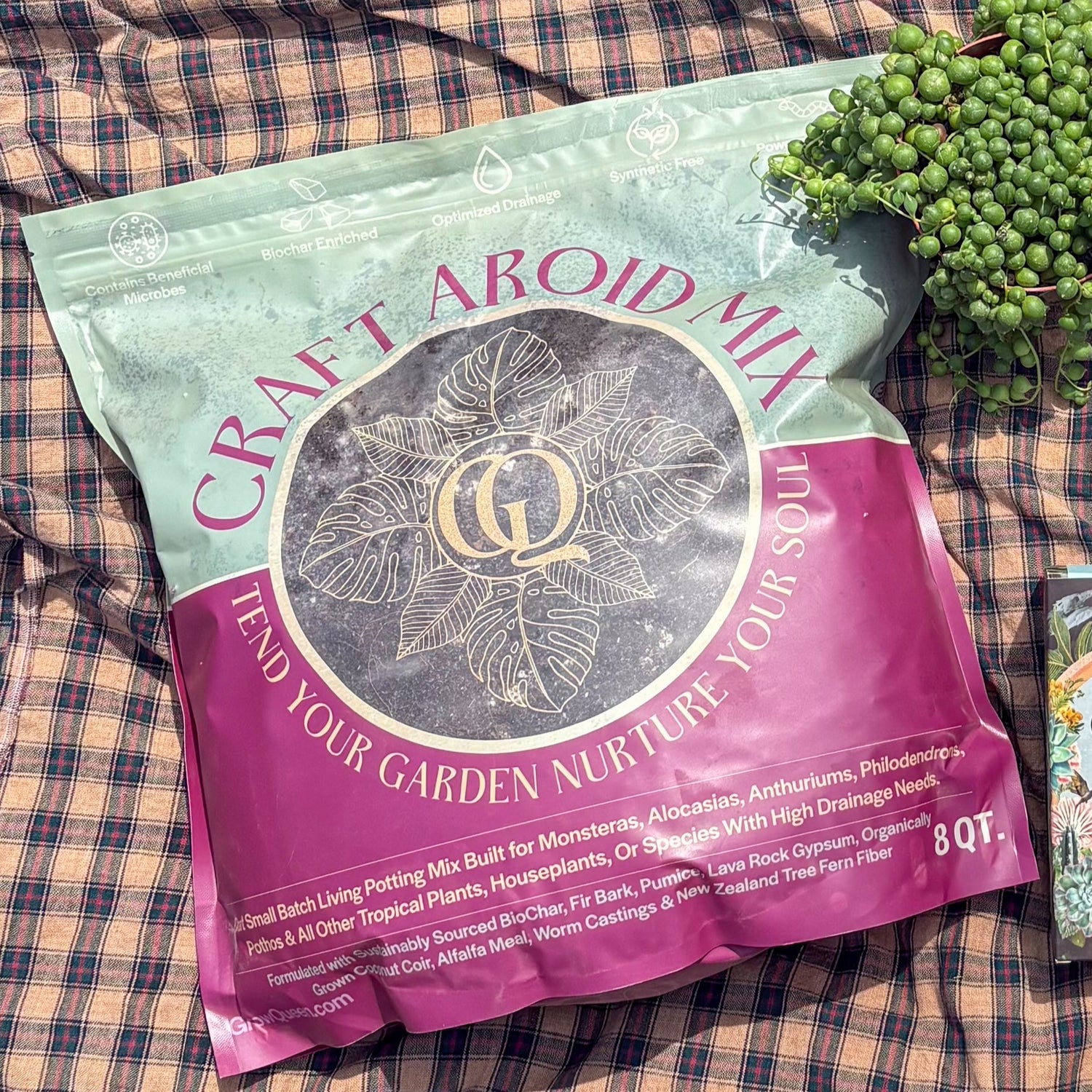
Every ingredient in Grow Queen's Craft Houseplant Potting Mix and Craft Aroid Potting Mix pulls pH in a known direction, and together they land at approximately pH 6.
Coco coir: a peat-free base that starts close to the target range, so no limestone is needed to correct it.
Fir bark, alfalfa, and earthworm castings: organic matter that feeds the plant and adds a gentle, steady acidity as it breaks down.
Charged biochar: an alkaline counterweight that keeps the mix from drifting too acidic and helps it hold nutrients.
Gypsum: calcium without a pH shift.
Pumice and lava rock: drainage and air space.
The result is a mix held in the range where micronutrients stay dissolved and available. Paired with the sulfate micronutrients in our dry and liquid plant foods, the mix does the work a synthetic chelate would otherwise be asked to do.
Keeping a Living Mix at the Right pH
Grow Queen's Craft mixes are bioactive, meaning they are living soil. Earthworm castings, alfalfa, and biochar carry and feed a population of beneficial microbes that keep nutrients cycling. Those microbes are part of what holds the mix near pH 6, and like any living thing, they need the right conditions to stay healthy, even while the mix is still in the bag.
According to NC State Extension, organic potting ingredients are very biologically active, and when their moisture, temperature, and oxygen are not managed, they can turn anaerobic, a state where the mix runs out of oxygen. Anaerobic mixes usually come with a drop in pH and a buildup of salts, both of which can damage plants. That is why every detail of how our mixes are packed and stored is designed to protect their pH:
Pre-moistened, never dried out: microbial activity depends on moisture. Our mixes ship lightly moist so the microbes inside stay active and the mix arrives balanced and ready to plant. Letting the bag dry out completely slows that biology down.
Tiny air holes in every bag: each bag is perforated with small holes that allow a very slight flow of air. That trickle of oxygen keeps the living mix from going anaerobic and souring while it waits on the shelf.
Stored cool and dry: keep the bag in a cool, dry place out of direct sun. Temperature also controls microbial activity, and heat speeds up the processes that shift pH. A dry storage spot keeps the outside of the bag clean while the moisture inside stays put.
Treat the bag the way you would treat the plant: not soaked, not bone dry, with a little air. Store it well, and the mix will still be sitting near pH 6 when you open it.
The right pH turns the nutrients in your pot into nutrients your plant can use.
References
Mickelbart, M. V., et al. Soil pH (HO-240-W). Purdue Extension.
Gatiboni, L., and D. Hardy. Soil Acidity and Liming for Agricultural Soils (AG-439-50). NC State Extension, 2022.
Pennisi, B. V., and P. A. Thomas. Essential pH Management in Greenhouse Crops: pH and Plant Nutrition (B 1256). University of Georgia Extension, 2023.
Wortmann, C. S., et al. Micronutrient Management in Nebraska (NebGuide G1830). University of Nebraska–Lincoln Extension, rev. 2013.
Evans, M. R. Greenhouse Management Online: Common Substrate Components. University of Arkansas, Department of Horticulture.
Penn State Extension. Biochar: Opportunities and Limitations for Soil Health and Water Quality.
Bilderback, T. E. Using the PourThru Procedure for Checking EC and pH for Nursery Crops. NC State Extension.
Sawyer, J. E., and D. W. Barker. Gypsum: An Old Product with a New Use. Iowa State University Extension.
Start With the Right pH
Craft Potting Mixes formulated to approximately pH 6, so the nutrients in your pot stay available to your plant.
Shop Craft Potting Mix →Use code MONSTERA10 for 10% off



0 comments