
Grow Queen · The science
Leaf Knight: The Science of Botanical Pest Control
Ever flipped a leaf over and found fine webbing, silver streaks, or a cluster of white fuzz? Spider mites, thrips, and mealybugs are three of the most common pests on indoor plants, and they are hard to spot until the damage shows. Leaf Knight is our answer: a ready-to-use miticide and insecticide made with four plant oils. This is the breakdown of how those oils work, why we made it, and how to use it so the pests stay gone.

Miticide
A product that kills mites, tiny eight-legged relatives of spiders that are not true insects.
Insecticide
A product that kills insects, such as thrips and mealybugs.
Essential Oil
A concentrated oil that carries a plant's aroma compounds, the same compounds many plants use to defend themselves.
Contact Spray
A spray that only works on the pests it actually wets, with no lasting effect once it dries.
Sources: Colorado State University Extension; University of Kentucky Entomology (ENTFACT-406); UConn Home & Garden Education Center.
The Three Pests Leaf Knight Targets
All three are sap feeders, meaning they pierce or scrape plant tissue and drain the fluid inside. Indoors, they have it easy. There are none of the predators that keep them in check outdoors, and according to Colorado State University, indoor populations can stay active year-round.
Spider mites: barely visible without magnification, they live on the undersides of leaves. Their feeding leaves tiny pale dots called stippling, and heavy infestations spin fine webbing. Dry air favors them, and in warm, dry conditions a full generation can develop in 10 days or fewer. A single female can lay around 100 eggs.
Thrips: slender insects only 1 to 1.5 millimeters long. They scrape the leaf surface and leave silvery patches speckled with tiny black spots. Females lay their eggs inside leaf tissue, where sprays cannot reach them.
Mealybugs: soft-bodied insects covered in white, powdery wax. They gather in leaf joints and stem crotches and leave behind honeydew, a sticky, shiny residue from the sap they digest.
How Plant Oils Work Against Pests
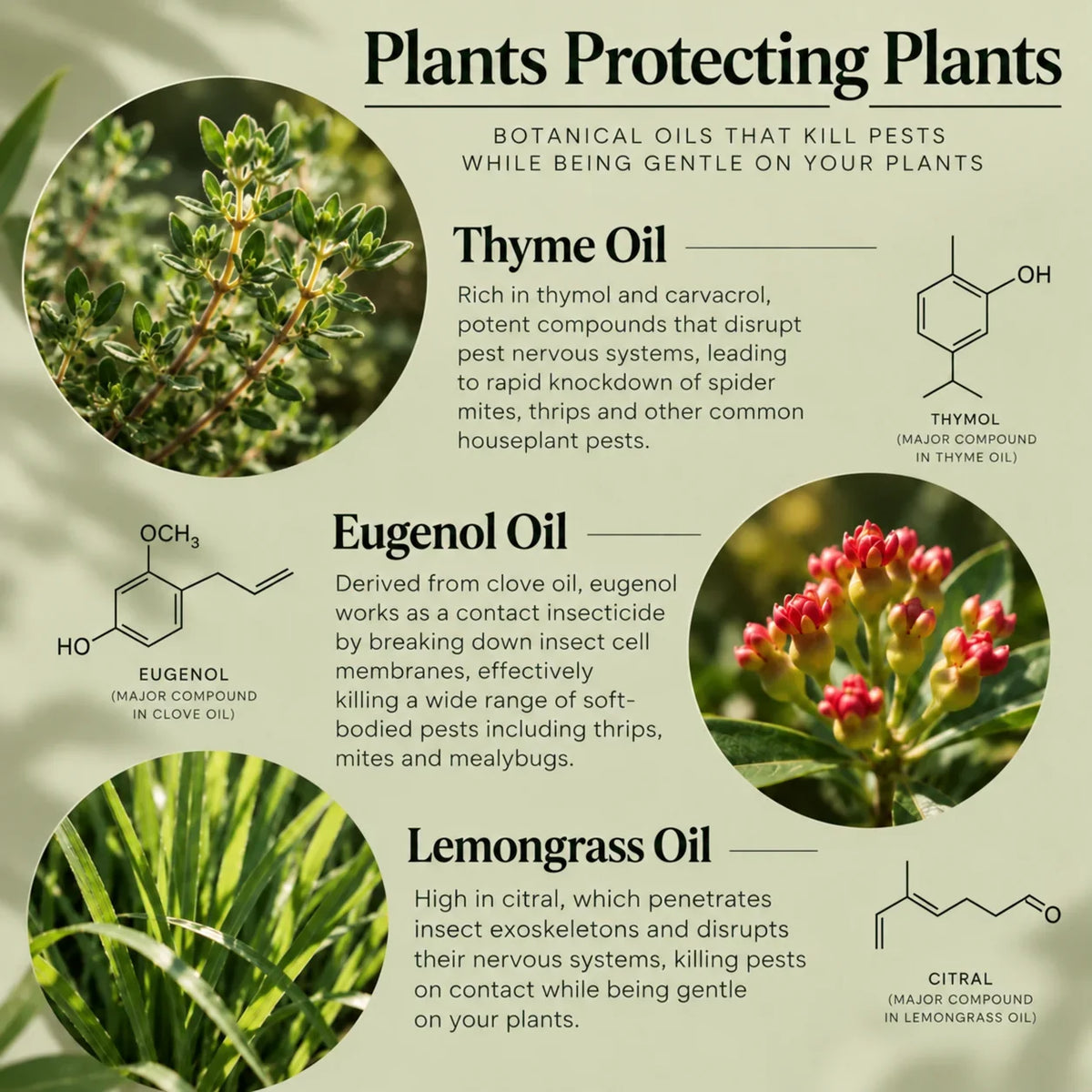
Plants cannot run from the insects that eat them, so many of them make their own defenses. Clove, thyme, lemongrass, and peppermint all produce strongly scented compounds in their leaves and buds. Concentrated into essential oils, those compounds can be turned back on the pests that attack houseplants.
Purdue University entomologists tested 15 essential oil compounds applied directly to insects. Among the most effective on contact were thymol, the main active compound in thyme oil, citronellic acid from lemongrass, and eugenol, the aromatic compound in cloves. When the researchers measured nerve activity, thymol and eugenol slowed down the insects' nervous systems.
The University of Connecticut describes eugenol as a fast-acting contact insecticide used on ornamental plant pests including mites and thrips. Essential oils also break down quickly and do not persist in soil or water. That is the trade-off: they leave little behind, so they work on the pests they touch and need to be reapplied to catch the next wave.
All four of Leaf Knight's active ingredients appear on the EPA's list of ingredients allowed in minimum risk pesticides, a category for substances the EPA considers low enough in risk to people and the environment that they do not require full registration review.
Inside the Bottle
Eugenol, 0.78%: the aromatic compound in cloves. A fast-acting contact insecticide that breaks down insect cell membranes and soft bodied pests.
Thyme oil, 0.70%: rich in thymol and carvacrol, one of the most active compounds known to disrupt pest nervous systems, proven by Perdue University.
Lemongrass oil, 0.34%: contains citronellic acid, also known as citrol, effective compound penetrates animal cell exoskeletons, while being gentle on plant cells.
Peppermint oil, 0.18%: rounds out the blend and gives Leaf Knight its herbal mint scent that nature uses as pest control.
Other ingredients, 98%: water, isopropyl alcohol, soap, glycerin, and citric acid, which together carry the oils and help the spray spread evenly across the leaf.
Why We Made Leaf Knight
Grow Queen is built on holistic plant care: living soil, organic plant food, and simple ingredients that work with a plant's biology. Pest control was the missing piece. The University of Kentucky notes that only a few insecticide products are available for treating plants inside the home, and many plant owners are left choosing between harsh sprays and homemade mixes. Colorado State University Extension advises against those homemade dish soap remedies, since they are not tested and household detergents can injure plants.
So we made the spray we wanted on our own shelves: plants protecting plants. Leaf Knight uses four botanical actives, comes ready to use with no mixing or measuring, cleans dust off leaves while it works, and can be sprayed with grow lights on or off. And it smells like an herb garden.
Why Every 7 Days Matters
A single spray can knock back the pests you see, but not the ones on the way. According to the University of Kentucky, spider mite eggs are not affected by insecticides. Thrips eggs sit inside leaf tissue, and Colorado State University notes that their non-feeding young mature in the soil, out of reach of any leaf spray.
That is why Leaf Knight is applied every 7 days for 3 to 4 applications. Each round catches the pests that hatched or emerged since the last one, until the cycle is broken.
How to Use Leaf Knight
Shake. Ready to use. Shake well before application.
Coat both sides. Spray the tops and undersides of leaves until coated. Contact sprays only work on the pests they touch, so coverage matters.
Wipe and dry. Wipe off the excess product from leaves using a microfiber towel, and allow the rest to dry.
Avoid direct sun. Keep out of direct sunlight for at least 4 hours after application. Apply at night if needed to reduce the risk of contact burn. Grow lights are okay.
Repeat weekly. Repeat once a week for 3 to 4 applications for best results.
Disclaimers
Plant care: Use discretion and care on new growth, buds, and stressed plants. Do not mix Leaf Knight with plant food or other sprays.
Safety: Wear gloves and eye protection, since the spray can irritate eyes and skin. Keep pets away from treated plants until the spray has dried. Keep product away from children and store in a cool, dry place.
Intended use: Leaf Knight is for indoor ornamental plants like monstera, philodendron, anthurium, calathea, alocasia, ficus, and snake plant, not intended for veggies herbs or consumption gardening.
Certification: This product has not been OMRI listed or organic rated, but has been carefully curated to kill pests on contact.
Tips To Keeping Pests From Coming Back
Quarantine new plants: keep new arrivals away from your collection for 30 days to make sure they are not carrying pests.
Check leaf undersides and petioles weekly: that is where spider mites their eggs hide, and many other pests hide.
Raise the humidity: spider mites thrive in dry air, and higher humidity indoors helps keep their numbers down.
Keep leaves clean: rinsing foliage washes off mites along with the dust that builds up on leaves.
Leaf Knight will be available everywhere online starting Friday, October 23. Click here to view the official product listing.
Plants protecting plants.
References
Townsend, L. Houseplant Insect Control (ENTFACT-406). University of Kentucky Department of Entomology.
Cranshaw, W. S. Insect Control: Insecticidal Soap (Fact Sheet 5.547). Colorado State University Extension, reviewed 2025.
Colorado State University Department of Agricultural Biology. Twospotted Spider Mite and Thrips.
UConn Home & Garden Education Center. Insecticides: Low Toxicity Options. University of Connecticut.
Gaire, S., M. E. Scharf, and A. D. Gondhalekar. Toxicity and Neurophysiological Impacts of Plant Essential Oil Components on Bed Bugs. Scientific Reports, 2019. Summary via Purdue University.
Baker, B. P., and J. A. Grant. Eugenol Profile and Thyme & Thyme Oil Profile. Cornell University New York State IPM Program, 2018.
Available Friday, October 23
Enjoy our newest product, Leaf Knight Miticide & Insecticide, at 20% off using this code.
KNIGHT20Use code KNIGHT20 at checkout for 20% off.






0 comments