
Grow Queen · The Science
Inside the Bag: EDTA vs. Sulfates, the Real Difference in Micronutrients
Ever wondered what really separates a synthetic fertilizer from a "natural" one? More often than not, the answer is hiding in the words on the ingredient label. This is the breakdown of EDTA versus sulfates, and how one difference shapes everything we put inside the bag.
Sulfate
A sulfate is a simple mineral salt: a micronutrient such as zinc or manganese paired with sulfate, a sulfur atom bonded to four oxygen atoms. When it dissolves in water, the pair separates and the micronutrient is released as a free ion that roots absorb directly, with nothing attached to it. Mineral sulfates are permitted in USDA certified organic production. This is the form Grow Queen uses.
EDTA
EDTA (ethylenediaminetetraacetic acid) is a synthetic molecule added to some fertilizers as a carrier for micronutrients. It is not a nutrient itself. Each EDTA molecule binds tightly to a single metal, such as zinc or iron, and keeps it dissolved so it cannot react with the soil before a root absorbs it. This binding is called chelation, and the combined molecule is called a chelate. EDTA does not occur in nature and is prohibited in certified organic fertilizer.
Sources: University of Nebraska–Lincoln Extension, Micronutrient Management (NebGuide G1830, peer reviewed); Iowa State University Department of Agronomy, Micronutrients (R. Voss).
Checking your fertilizer bottles for trace minerals, you'll find zinc, manganese, copper, and iron. What almost never gets explained is the chemical form attached to each one, which usually represents either a sulfate or a synthetic chelate like EDTA. That form determines how nutrients move through soil, how long they persist in the environment, and whether they can be considered organic. Here is the science behind our system's micronutrients.

The Role of Micronutrients in Container Systems
Zinc and manganese act as enzyme cofactors, iron is essential to chlorophyll synthesis, and copper supports electron transport during photosynthesis. When any one is deficient, growth is limited regardless of how much nitrogen, phosphorus, or potassium is supplied.
The catch is that a pot is a closed system. In natural ecosystems, soils and substrates are gradually replenished through mineral weathering and the decomposition of leaf litter and organic matter. That process does not occur inside a container. Trace minerals are not naturally replaced, and they are not typically included in most big brand potting mixes. Supplementation is what maintains these nutrients at levels that support vigorous growth rather than bare survival. Whether that supplementation comes from a dry food or a liquid one, Grow Queen is helping make holistic plant care easily accessible.
EDTA: Synthesis and Chelation Chemistry
EDTA was first synthesized in 1935 by Austrian chemist Ferdinand Münz as a substitute for citric acid. Modern industrial production reacts ethylenediamine with formaldehyde and sodium cyanide, then acidifies the product with hydrochloric or sulfuric acid to precipitate EDTA from solution.
Chemically, EDTA is a hexadentate ligand: a single molecule binds one metal ion at six points simultaneously, forming a highly stable ring structure. The micronutrient remains present, but it is held within the EDTA complex rather than existing as a free ion. That stability keeps metals soluble in high pH agricultural soils and hydroponic systems, which is where synthetic chelates are primarily used.
It is also why EDTA is excluded from organic production. EDTA is not readily biodegraded, can build up in soil, and can carry metals through soil and river sediments. In 2007, the USDA National Organic Standards Board unanimously rejected a petition to permit an EDTA-based compound in organic agriculture, citing both its environmental behavior and the toxic chemicals required to manufacture it.
How EDTA Appears on a Fertilizer Label
EDTA is rarely printed prominently. Under state labeling law, a chelated micronutrient is guaranteed separately, and the chelating agent is named only in the "Derived from" fine print.
Guaranteed Analysis
Iron (Fe) . . . . . . . . . . . . . . . . 0.10%
0.10% Chelated iron
Zinc (Zn) . . . . . . . . . . . . . . . . 0.05%
0.05% Chelated zinc
Derived from monoammonium phosphate, potassium nitrate, urea, monopotassium phosphate, sodium borate, copper EDTA, iron EDTA, manganese EDTA, sodium molybdate, and zinc EDTA.
Excerpt from the published specimen label of a commercial water-soluble 20-20-20 fertilizer. Highlighting added.
Look for "chelated" in the Guaranteed Analysis and a metal paired with EDTA in the derivation statement. It may also appear as Fe-EDTA, sodium ferric EDTA, or disodium EDTA. A sulfate source simply names the salt: zinc sulfate, manganese sulfate, copper sulfate.
Where Else EDTA Is Used
Food preservation: binds trace metals that catalyze spoilage in dressings, mayonnaise, and canned beverages.
Endodontic irrigation: a 15 to 17 percent solution dissolves the mineral smear layer during root canal treatment.
Anticoagulation: coats blood collection tubes, binding the calcium required for clotting.
Chelation therapy: administered intravenously to bind heavy metals such as lead for excretion.
Each use depends on EDTA holding metals tightly and persistently in a closed, controlled system. In soil and water, that persistence becomes a liability.
How Sulfates Interact with Soil
Whether a sulfate stays available to a plant depends largely on pH. Zinc, copper, and manganese become more available as pH drops toward slightly acidic, and with the exception of molybdenum, micronutrient availability declines sharply above pH 7.5. In alkaline conditions, free metal ions react with the soil and lock up before roots can reach them.
"Organic" here refers to certification, not chemistry. In chemistry, organic simply means carbon based, which is why sulfates are technically classified as inorganic, yet the USDA permits mineral sulfates in certified organic production and prohibits EDTA. What matters for certification is how an input behaves in a living system.
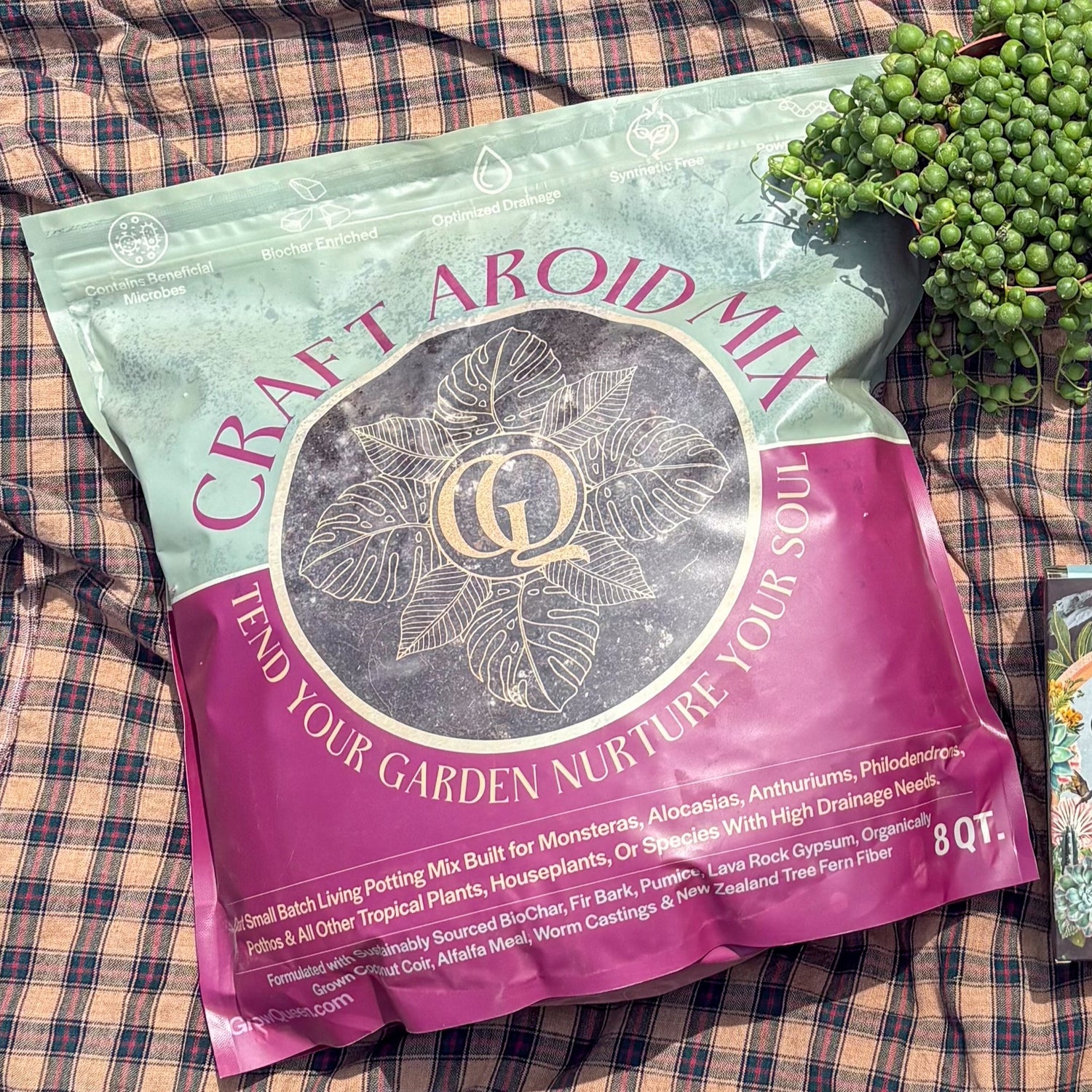
Organic potting substrates are carbon rich by nature, built from peat, coir, bark, compost, and other plant derived organic matter, and that organic matter helps hold micronutrients in plant-available forms on its own. Grow Queen's Craft Houseplant Potting Mix and Craft Aroid Potting Mix are both formulated to a pH of approximately 6, squarely in the range where sulfate micronutrients stay soluble and available. In the right substrate, there is no need for a synthetic carrier.
Sulfates vs. EDTA
Availability: Sulfates are immediately available in slightly acidic substrates. EDTA stays soluble across a wider pH range.
Persistence: Sulfate ions are taken up by roots or cycled by soil biology. EDTA resists biodegradation and can accumulate in the root zone over repeated feedings.
Environmental impact: Sulfates remain in the soil nutrient cycle. EDTA can mobilize metals into sediments and groundwater.
Organic certification: Sulfates are permitted. EDTA is prohibited.
Grow Queen's Formulation Approach
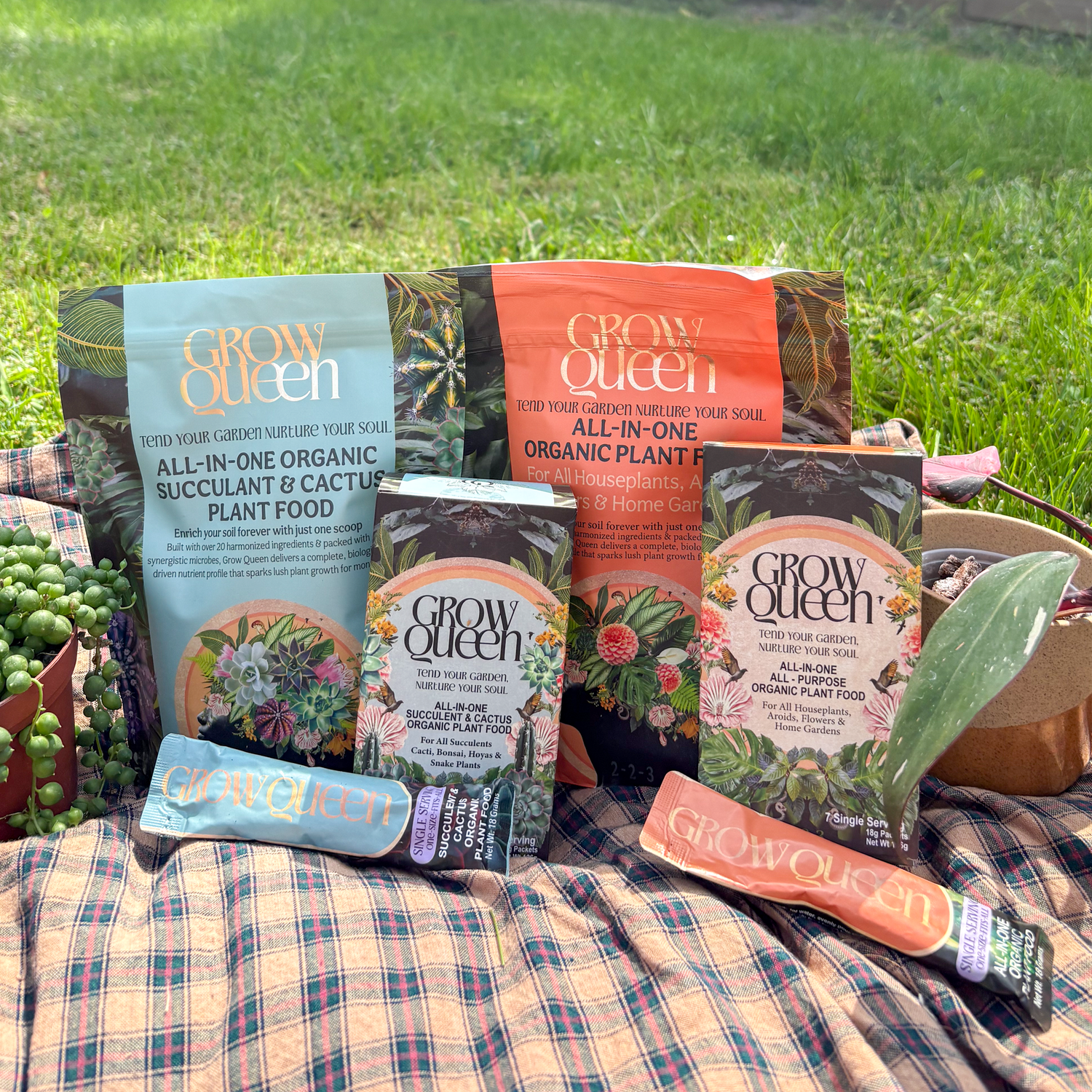
Every trace mineral in Grow Queen formulas, zinc, copper, and manganese, is supplied in sulfate form and supplemented by kelp, across both the Organic Time Release dry feed and the Organic 5-5-5 Liquid Plant Food. Paired with potting mixes held near pH 6 and the biochar, humates, and microbial inoculants in our formulas, those minerals stay available and cycling without synthetic chelation. Here is how that reads on our own labels.
Dry Food: Organic Time Release Plant Food
Guaranteed Analysis
Nitrogen (N) . . . . . . . . . . . . . . 2.09%
Phosphate (P) . . . . . . . . . . . . . 1.77%
Potassium (K) . . . . . . . . . . . . . 2.66%
Copper (Cu) . . . . . . . . . . . . . . 0.01%
Iron (Fe) . . . . . . . . . . . . . . . . 0.38%
Manganese (Mn) . . . . . . . . . . 0.32%
Zinc (Zn) . . . . . . . . . . . . . . . . 0.37%
Derived from neem and karanja seed cake meal, alfalfa meal, soft rock phosphate, fish bone powder, non-GMO soybean meal, malted barley, gypsum, oyster shell flour, potassium sulfate, zinc sulfate, copper sulfate, manganese sulfate.
Liquid Food: Organic 5-5-5 Liquid Plant Food
Guaranteed Analysis
Total Nitrogen (N) . . . . . . . . . . 5%
Available Phosphate (P₂O₅) . . . 5%
Potassium (K₂O) . . . . . . . . . . . 5%
Copper (Cu) . . . . . . . . . . . . . . 0.01%
Zinc (Zn) . . . . . . . . . . . . . . . . 0.37%
Manganese (Mn) . . . . . . . . . . 0.32%
Derived from Ecklonia maxima bull kelp seaweed, soft rock phosphate, potassium sulfate, soybean hydrolysate, zinc sulfate, manganese sulfate, and copper sulfate.
Soil: Craft Houseplant & Craft Aroid Potting Mix
Ingredients
Coco coir, fir bark, pumice, lava rock, earthworm castings, charged biochar, alfalfa, gypsum, and redwood bark fiber (Houseplant) or New Zealand tree fern fiber (Aroid).
Formulated to approximately pH 6, the range where sulfate micronutrients stay soluble and available.
Excerpts from Grow Queen product labels. Highlighting added.
Notice what is missing: no "chelated" guarantees and no EDTA in any derivation statement. Every micronutrient is listed by its sulfate salt.
Simple minerals, living soil, and no synthetic chelates standing in between.
More Science to Come
If you have made it through all of this science and are still asking yourself what pH actually is, or what exactly makes something a micronutrient, not to worry. This post is part of an ongoing series, and upcoming entries will continue to break down the science behind organic fertilizers and micronutrients, one piece at a time.
References
Wortmann, C. S., et al. Micronutrient Management in Nebraska (NebGuide G1830). University of Nebraska–Lincoln Extension, rev. 2013.
Voss, R. Micronutrients. Iowa State University, Department of Agronomy.
Shaddox, T. W. The Florida Fertilizer Label (SL-3/SS170). University of Florida IFAS Extension.
USDA National Organic Standards Board. Formal Recommendation: Sodium Ferric Hydroxy EDTA. 2007.
U.S. Code of Federal Regulations. 7 CFR 205.601: Synthetic Substances Allowed for Use in Organic Crop Production.
Micronutrients, Made Simpler
Give your plants the trace minerals they need without a synthetic carrier left behind in the soil. Feed smarter with Grow Queen.
Shop Grow Queen Plant Food →Use code MONSTERA10 for 10% off
0 comments