
Grow Queen · Women in stems
The Begonia Queen
Eva Kenworthy Gray
The angel wing begonia has a long, tangled family tree, and one of its most important branches was grown by a woman at home in California.
You have almost certainly admired an angel wing begonia: those tall, cane-like stems, the wing-shaped leaves splashed with silver polka dots, the dangling clusters of coral and pink flowers. What fewer people know is the story behind them: a lineage that stretches back to a Swiss hybrid in the 1890s and was carried forward by a wave of passionate amateur breeders. Chief among them was Eva Kenworthy Gray, often remembered as a queen of the angel wings.
At Grow Queen, we have a soft spot for women who have made their mark on the plant world. So this one is a tribute to a Begonia Queen, and a guide to caring for the plants she helped give us.
She was not a professional botanist. She was a curious woman with a windowsill and a question.

A Curious Woman and a Windowsill
Eva Kenworthy Gray was born in Missouri in 1863 and, unusually for a woman of her era, received a university education. Later in life she made her way west to California, and it was there, in 1920, after someone handed her a couple of begonia cuttings, that she fell completely, happily under the spell of begonias.
For most people, a gifted cutting is just a new plant on the shelf. For Eva, it was the beginning of an obsession. By 1926 she had launched her own at-home hybridizing program, crossing fibrous begonias to see what new beauty she could coax into existence.
The Angel Wing’s Tangled Roots
Angel wings did not appear overnight, and they were not the invention of any single person. The cane begonia group they belong to reaches back to the 1890s. One of the oldest and most beloved cultivars, Begonia ‘Corallina de Lucerna’ (usually just called ‘Lucerna’) was raised by a Swiss grower in 1892 from a cross of Begonia aconitifolia and B. coccinea. With its olive leaves flecked in silver, ‘Lucerna’ went on to parent countless varieties.
So by the time Eva picked up her shears, the raw material of the angel wing already existed. What she did was take it somewhere new.
Eva’s Legacy: Pioneering the Superbas
In 1926, working at home in California, Eva crossed the Brazilian Begonia aconitifolia with that same Swiss ‘Lucerna’, and did not stop there. Her breeding program is credited with pioneering the celebrated Superba strain of cane begonias: robust, upright plants with dramatically cut, silver-speckled leaves.
She was not working alone, either. Eva was part of a wave of dedicated amateur hybridizers, including women like Irene Nuss and Belva Kusler, who together shaped the angel wings we grow today. Over the years, the name “angel wing” spread well beyond her plants to describe almost any begonia with those pointed, wing-shaped leaves.
She could not have predicted the success her little program would engender.
Today, angel wings are among the most popular begonias in the world, with countless named cultivars, and Eva’s Superbas remain a landmark: proof of how far a curious home gardener can move an entire group of plants.
What Makes an Angel Wing an Angel Wing
Angel wings belong to the fibrous cane begonia group. They grow upright on thick, bamboo-like canes, and they earn their keep twice over, with striking foliage and a long bloom season.
The leaves are the showstopper: folded and feathery, often speckled, polka-dotted, banded, or splotched, sometimes in metallic silver, frequently with a contrasting color on the underside. Their margins are lobed, wavy, and deeply etched. Above them hang heavy clusters of flowers in cherry red, orange, salmon, pink, and white.
Native to the tropics and subtropics, angel wings make wonderful year-round houseplants, and genuinely easy once you understand what they want.
How to Care for Your Angel Wing
Like most begonias, angel wings love warmth, high humidity, good air circulation, and a careful hand with water. Here is how to keep yours thriving.
Light
A bright east or west window is ideal. Bright light deepens those leaf colors and encourages flowering. If you move the plant outdoors for summer, give it partial shade, since direct sun will scorch the leaves.
Temperature & humidity
Aim for 70 to 75°F during the day and no cooler than 60°F at night, with high humidity and airflow around the plant.
Water
Water only when the soil has dried, and err on the side of withholding. As begonia expert Tovah Martin put it, the relationship is really about learning how to withhold water properly. Soggy soil is the fastest way to lose one.
Feeding
Feed monthly during the growing season (spring through fall), and go gentle. Overfeeding pushes leggy, excessively caney growth rather than a full, balanced plant, which is exactly why a mild, balanced organic feed suits them so well.
Pruning
When a young plant reaches 6 inches, pinch the top shoot to encourage bushy lateral growth. Prune out any single cane that races ahead with few leaves. Once the plant is a year old, cut it back hard, down to about 6 inches, in winter and again in late spring to keep it compact and rounded.
Feed gently, water carefully, prune bravely, and an angel wing will reward you for years.
A Few Cultivars to Know
Breeders have carried Eva’s work forward into hundreds of varieties with flashier foliage, more compact habits, and longer bloom. A few worth seeking out: ‘Anna Christine’, ‘Charles Jaros’, ‘Esther Albertine’, ‘Jim Wyrtzen’, ‘Splish Splash’, ‘Silver Wings’, and ‘Looking Glass’.
The Grow Queen Tribute
Eva Kenworthy Gray never set out to build an empire. She simply followed her curiosity, learned her plants, and shared what she grew. Nearly a century later, that curiosity is still blooming on windowsills all over the world.
That is the spirit we try to honor at Grow Queen: grow with intention, feed your plants well, and pass the love along. Whether you are tending your first begonia or your fiftieth, you are part of a story that curious growers like Eva have been writing for a century, one cutting at a time.
Long live the Begonia Queen.
Grow With Intention
Give your begonias the gentle, balanced, no-burn nutrition they deserve.
Shop Grow Queen Plant Food →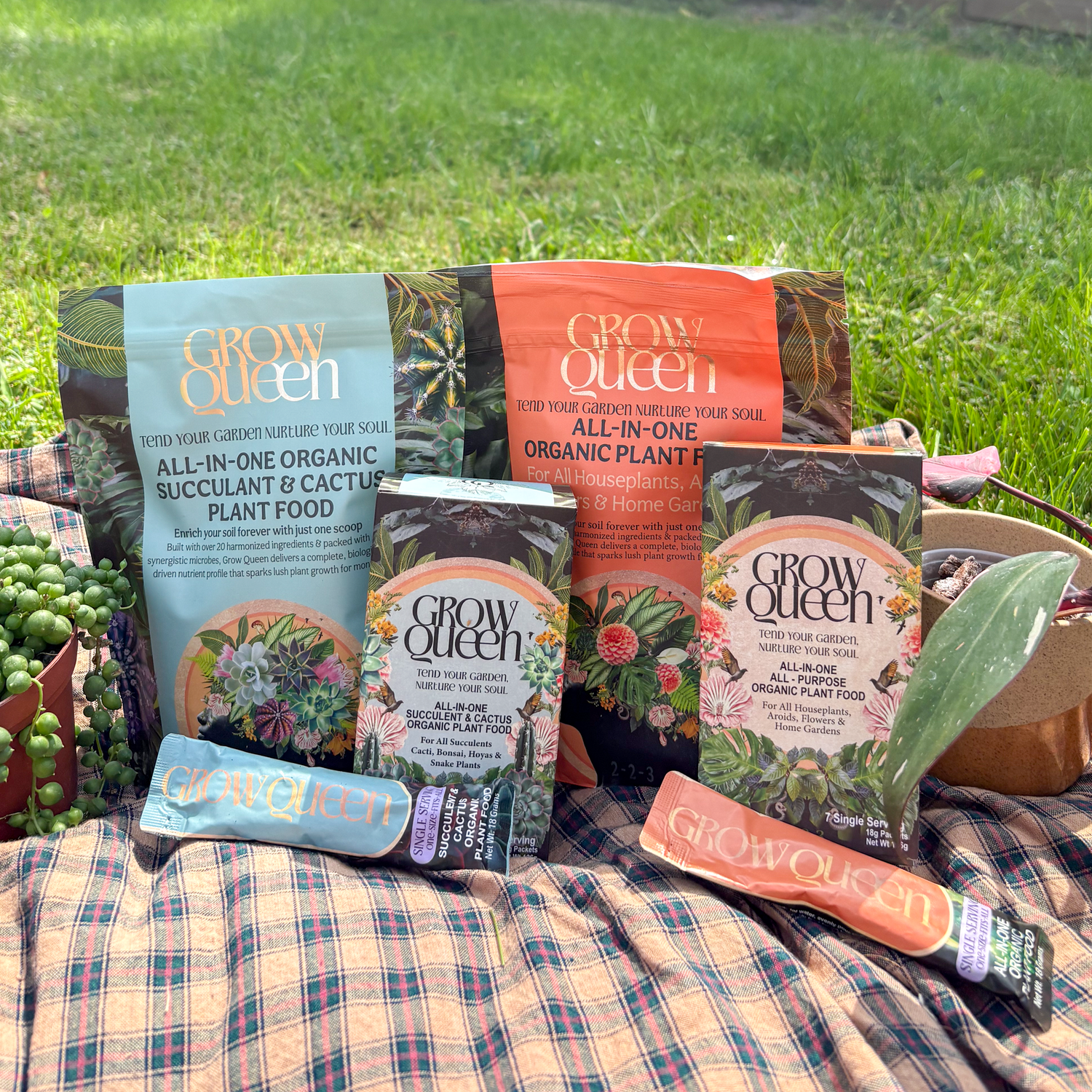
0 comments